Writing Transfer Guide
ROLE
Research, design, writing
DESCRIPTION
PAPER is on online tutoring company where tutors provide support via chat. Sometimes students get the wrong subject, and tutors need to transfer the student. Improper transfers of writing students have become more common, and cause significant student and tutor frustration. This resource aims to support tutors through the process of transferring.
YEAR
2023
PROJECT TYPE
Internal employee support documents
SKILLS USED
Guerilla research, focus group testing, personas.


Formative Research
We needed to know more about how tutors feel about handoffs, and what pain points they encounter.
A mass survey would be ideal, but was not practical given project constraints.
Instead, I conducted guerilla testing, and collected and analyzed a month's worth of Slack posts and threads between tutors following a major, mandatory handoff training module. This provided a wealth of data and insights into tutors' pain points within transfers of various kinds. I open-coded the data to quantify the information.
Quantitative Insights
.png)

The data revealed some surprises.
We expected the majority of comments to be negative, and we certainly saw a lot of negative emotions expressed. However, the top four most commonly expressed emotions were a balance of negative and positive. We can also see, by categorizing individual posts as either optimistic, pessimistic, or neutral in perspective, that the positive and negative feelings towards transfers are fairly well balanced.
Qualitative Insights
I pulled quotes that provided deeper insight into pain points, anxieties, and behaviours of tutors when transferring writing students. These quotes became a key part in the creation of our personas.
Findings
Tutors' emotional response to transfers is fraught, with a fairly even split between positive or optimistic emotions, and negative or pessimistic emotions. This resource should relieve some anxieties and clarify some points that are causing widespread frustration and anxiety.
Tutors are highly anxious about assessment scores. To ensure tutors adopt the resource, it must be reviewed and approved by both the Teaching and Learning team, and the Quality Assurance team. This should reassure tutors that the resource is accurate and true to policy.
Some tutors have a visceral negative reaction to receiving topics outside of their concept map. This resource should help support them through transfers by externalizing the process of transferring.
There is a definite need for this type of resource, and this is an ideal time to implement such a resource.
Design
I used our research to create three representative personas to help us better understand the different approaches tutors take to transferring out writing students.
Personas


Rough Design
With personas based on our research, I began creating a rough version of the resource in FigJam.
FigJam allowed us to share the rough resource with our focus group, and to collaborate on content tweaks.
Flowchart
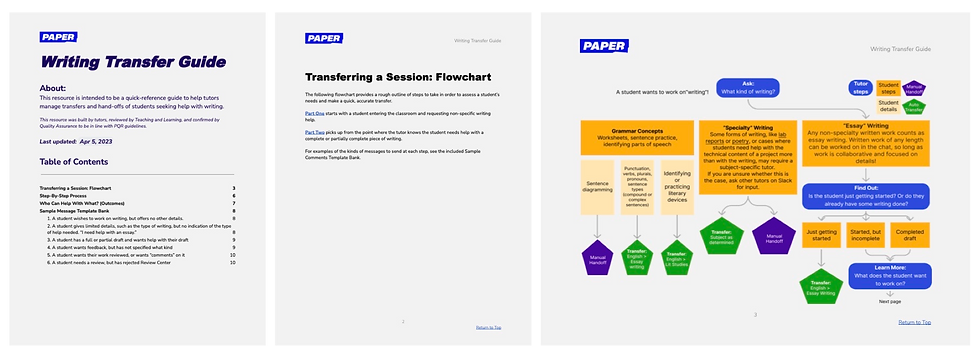
For the anxious Dexters in our tutor group, we created a highly detailed flow chart. This is a resource tailor-made for tutors who like fine detail, and want to be guided through every step of the process, and who are especially anxious about their assessment scores.

Step-by-Step
For our slightly-forgetful, but calm Sathas, we created a looser step-by-step guide. This version is easily referenced and serves more as a signpost or reminder than a detailed guide.

Transfer Goals
Finally, we created a set of transfer goals for our confident and goal-oriented Brunos. This version helps remind tutors of why we send students to different categories, while allowing tutors to freely guide the session however they feel comfortable.

User Testing
We solicited feedback from new tutors as well as experienced tutors to verify that our resource was clear, accurate, and useful.

New Tutors
We sent the rough resource to a couple of new STEM tutors, as part of our key target demographic, to get asynchronous feedback. New tutors do not have the ability to participate in focus groups.

Full-Time Tutors
We conducted a focus group made up of a mix of full-time STEM and humanities tutors. These tutors are experienced and able to provide valuable insights into the resource's accuraacy.
Findings
The new tutors were able to easily understand the resource without any guidance or introduction, and made use of it right away in sessions. One new tutor did point out an accessibility flaw, and we were able to edit the resource to be completely colour-blind friendly.
Our focus group tutors showed great excitement over the resource. Tutors appreciated the variety of formats, and contributed additional comments for our sample message bank. Tutors specifically requested that we keep the font sizes as large as possible for visibility. Focus group tutors unanimously agreed that the resource would have been useful to them as new tutors, and about half stated that it would still be useful to them today.
Next Steps and Final Reflections
The final document is currently being reviewed internally before release.
Assessing the resource's success will be challenging, but I have included a link to a Google Docs survey within the resource, in the hopes of capturing feedback from users.